
The Green SpiralPanels Impact

Environmental Protection
Today, forest destruction is occurring to secure land for solar power generation; SpiralPanels can help minimize this environmental damage.

Ecofriendly Power Generation
By enabling high electricity output on a smaller footprint, SpiralPanels makes renewable generation feasible even on land-constrained sites, supporting cleaner energy deployment without expanding into new natural areas.

Wide Space Efficiency
The usable open space between structures can be repurposed for other needs—such as agriculture, road construction, or housing.
SpiralPanels' Expedition of Renewable Transition
According to the Korea Energy Economics Institute, CAPEX accounts for about 57% of LCOE. Therefore, a 40% reduction in CAPEX would translate into an estimated 22.8% reduction in LCOE (0.57 × 0.40).
LCOE Reduction
Woo, C.K. (2024) estimates an adoption response of roughly −5.34 to price declines (i.e., adoption rises as costs fall). Using this relationship, a 22.8% drop in LCOE implies an estimated ~2.23× increase in solar adoption.
Increase in Solar Adoption
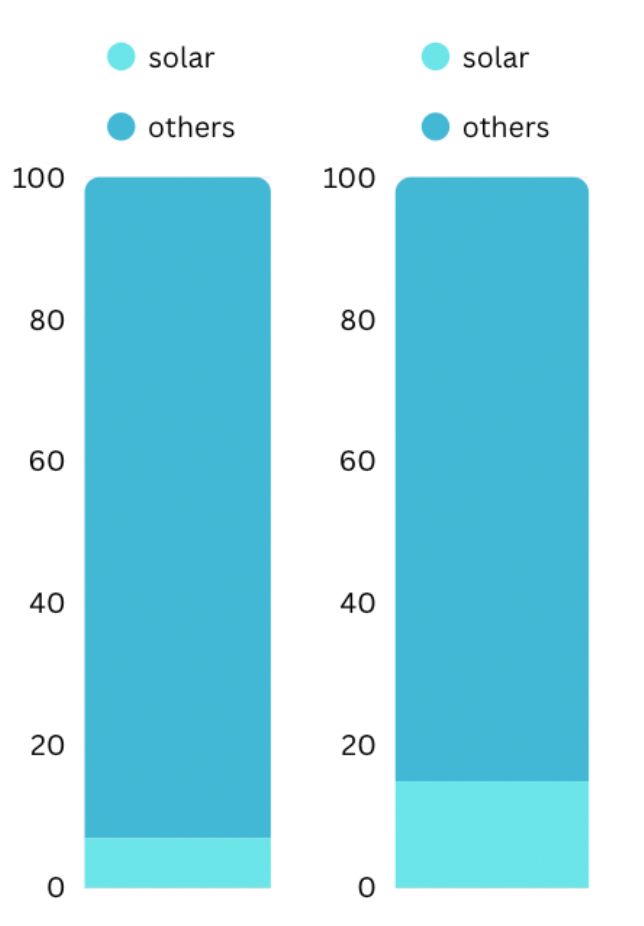
Currently, solar accounts for about 7% of global electricity generation. If solar adoption increases by ~2.23×, solar’s share could rise to roughly ~15%, and overall renewable adoption could increase by around ~5 percentage points as solar expands within the energy mix.
Expedited Transition
By lowering LCOE and increasing output per footprint, SpiralPanels reduces two key bottlenecks—cost and land constraints—making it easier to deploy solar at scale and helping countries close the gap toward major renewable expansion targets.
Achieving Global Goals

SpiralPanels' Carbon Emission Reduction
Based on the experimental results, a conventional single-layer solar panel produces 1.6 W per m², while the SpiralPanels model produces 5.1 W per m².
Therefore, SpiralPanels provides an additional 3.5 W per m² compared to the conventional model. Over the experimental time window, this corresponds to 10.5 Wh of additional energy per m².
Using Korea’s grid emission factor (kgCO₂/kWh) to convert this into carbon reduction per square kilometer, the estimated reduction is 5,019 kgCO₂ per km².
Applying the carbon reduction rate of SpiralPanels to South Korea's solar power generation grid size, it is estimated that the model will reduce 362,320 tCO₂ every year.
In Korea


Considering the global solar power generation grid size of 2.2TW, SpiralPanels model can save about 28.30 million tCO₂ annually.