Meet SpiralPanels.

A Spiral Multi-Layer Solar Power Generation Model
Incorporating Dual-Axis Active Reflection Panel Solar Tracking

Renewable Transition is SLOW.
Even if every country fully achieves their NDCs, the 2030 COP28 goal of “tripling renewable energy capacity” would still fall short by about 30%.
A significant bottleneck to renewable energy transition, especially solar power, is the massive land it consumes:
A 1 MW power plant requires about 5.7–8.2 acres of land.

56%
Share of the total workforce needed to build a power plant that is required for site (land) preparation
(Source: IRENA)
60%
Share of land costs in total CAPEX when purchasing land
(Source: Solar IT company Haezoom )
33%
Share of land costs in O&M costs when leasing/renting land
(Source: IRENA)
Structures have been developed, but they are limited.
Vertical Dual-Side PV

Limited Usage Area
Effectiveness may vary depending on the region and local conditions (e.g., ground surface/material). Depending on the sun’s elevation angle, only one side of the panels is usable (Gul, M. S. et al.).
Solar Tracking System
.webp)
System Intricacy & Electricity Consumption
Moving the entire solar panel array increases wiring and system complexity and raises electricity consumption. (Sadeghi et al.)
Multi-layer System
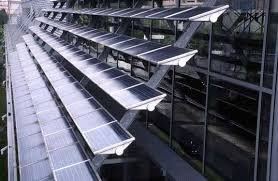
Shadow From Upper Layers
Depending on the sun’s elevation, the upper layer can shade the lower layer, causing shading losses and reduced efficiency. (Chacko & Thomas)
Introducing SpiralPanels.
The solution is here.
.png)
In layered PV system, upper floors cause shadow to lower floors. SpiralPanels' reflection panels that are installed each floor reflect solar rays to their respective floors, removing shadow and maximizing electricity output.
2. Lightweight Reflection Panel
Maximize the number of PV panels that can be installed in a limited area, increasing panel-land density.
1. Multi-layer system up to 8 floors
In order to best cast sun rays to their respective floor, SpiralPanels' proprietary solar tracking algorithm controls each reflection panel independatly according to sun's altitude. By controlling not the PV panel but the lightweight, easy-to-adjust reflection panels, SpiralPanels minimizes electricity consumption.
3. Dual-Axis Active Solar Tracking Algorithm
Dual-Axis Active Solar Tracking System


The reflective panel moves along two axes:
Tilt (Ground-Angle) Control
For a given tilt angle θ, we geometrically calculate—based on the sun’s zenith angle z—whether sunlight reflected by the reflective panel can reach the edge of the solar panel.
Azimuth Control
The sun’s zenith angles 0° and 90° are set as discrete control endpoints, and the angles in between are divided and arranged evenly as discrete control values.

Theoretical Impact of SpiralPanels
4X
Land Efficiency
40%
CAPEX Reduction


